

Inquiry Based Instruction: Establishing Critical Thinkers
- Nov 11, 2017
- 2 min read
As I am beginning to round out my Fall semester, we are still grinding away in Agricultural and Extension Education. The past two weeks have consisted of some incredible instruction regarding inquiry based teaching.
First, what is inquiry-based teaching? It is essentially a scientific approach to a lesson where students drive the class while moving through the scientific method from an observation to a conclusion.
Second, why is this so important? Inquiry-based teaching is so important because it creates CRITICAL THINKERS!! Students have to think deeply, make connections to other knowledge, and test what they know to discover information they do not. Additionally, students are able to learn the scientific method, conduct experiments, and even compete in the Agri-Science competition if they wish.
The "in's and out's" of Inquiry
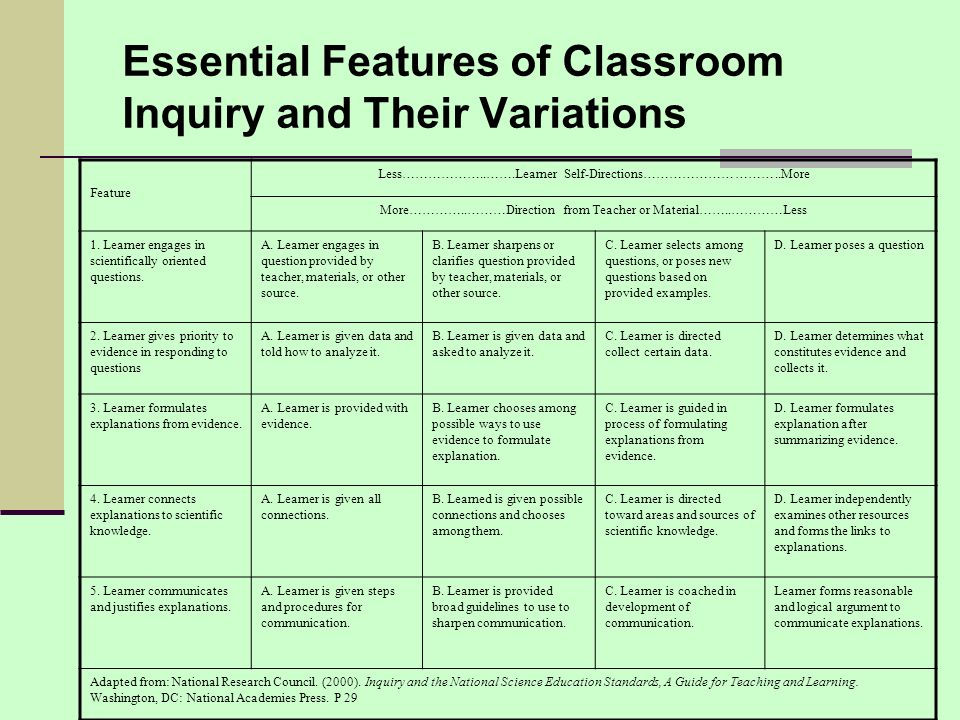
Inquiry-based teaching is all centered around students, using the rubric below. Essentially, there are 5 really important categories that are addressed in inquiry teaching. They are: engaging in a question, collecting evidence, formulating explanations, connecting scientific knowledge, and justified communication. What makes inquiry unique, is that the teacher can provide or tell the student what to do within these categories, or the students can be in charge. The goal is to shift towards column D, but you DO NOT always have to be in column D. If you were, you would be doing a disservice to your students. Most likely, in any given lesson you will be all over the board from A to D, and that is okay.
Personal Reflection:
After teaching an inquiry lesson on water quality testing to determine where certain fish species can live, I have some new perspectives on this topic. The main take-away from my lesson was learning to use the Socratic Questioning Technique. In inquiry, it is very common for students to ask a lot of questions because it is designed to not spoon feed them. Thus, how do you handle all the questions? One method is the Socratic method. This is all about turning the question back to the student. For example, if a student asks "what type of fish species are we relocating," it would be appropriate to ask them, or the entire class, what species of fish we would find in the local area. Thus, the student or other students answer the question. This is one method that I am trying to get better at so that I can develop deep and critical thinkers!

Comments